Buying a House with Student Loans: How to Qualify in 2026


Key Terms in This Article
- Back-End Ratio (Total Obligations Ratio)
- Your total monthly debt payments (mortgage, student loans, car loans, credit cards) divided by gross monthly income. Most lenders require this to be 43% or lower.
- Cost of Attendance (COA)
- The total amount it costs to attend your school for one academic year, including tuition, fees, housing, books, transportation, and personal expenses. Federal student loans can cover expenses within your school's official COA.
- Debt-to-Income Ratio (DTI)
- A percentage measuring how much of your gross monthly income goes toward debt payments. Lenders use this to determine how much mortgage debt you can afford.
- Deferment
- A period when you are not required to make student loan payments, typically while enrolled at least half-time or during economic hardship. Interest may not accrue on subsidized federal loans during deferment.
- Forbearance
- A temporary postponement or reduction of student loan payments granted due to financial difficulty. Interest accrues on all loan types during forbearance.
- Income-Driven Repayment (IDR)
- Federal student loan repayment plans (SAVE, IBR, PAYE, ICR) that calculate monthly payments based on income and family size rather than loan balance. Payments can be as low as $0.
- Installment Debt
- Loans with fixed payment amounts over a set term, including student loans, car loans, and mortgages.
- NSLDS (National Student Loan Data System)
- The U.S. Department of Education's central database containing information on all federal student aid. Mortgage lenders access this to verify loan balances and repayment status.
- PITI
- Principal, Interest, Taxes, and Insurance. The four components of a monthly mortgage payment that lenders use to calculate your front-end ratio.
- Qualified Mortgage
- A category of home loans meeting specific Consumer Financial Protection Bureau standards, including a maximum 43% debt-to-income ratio.
- Rehabilitation
- A process for federal student loan borrowers in default to remove the default status by making nine voluntary, on-time monthly payments within 10 months.
Table of Contents
Key Takeaways: Navigating Homeownership with Student Debt in 2026
I. Introduction
- The Reality of Buying a Home with Student Loans
II. The Math of Mortgage Approval: DTI and Loan Types
- How Student Loans Rffect your Debt-to-Income ratio (DTI Math)
- Scenario: Getting a Mortgage with $100k in Student Debt
III. Credit Scores and Daily Living
- Will Student Loans Affect My Credit Score? (Installment vs. Revolving)
- Can I Use Student Loans For Rent While Saving for a House?
IV. Strategic Financial Planning
- Should You Pay Off Loans or Save for the Down Payment
- Verifying Student Loans for a Mortgage: What lenders look for
- The 50/30/20 Rule For Student Loans and Homeownership
V. Frequently Asked Questions (FAQ)
VI. Conclusion: Your 2026 Path to Homeownership
- Moving Forward: Balancing Education Debt and Real Estate Goals
Key Takeaways
-
Monthly payment matters more than balance. Lenders calculate DTI using your monthly payment, not total debt. Borrowers with $100,000 in loans on income-driven repayment ($200/month) often qualify more easily than those with $50,000 on standard repayment ($550/month).
-
Documentation unlocks better DTI calculations. FHA lenders use 1% of your balance by default, but providing income-driven repayment proof drops this to 0.5%. Conventional loans may accept a documented $0 payment. This difference can mean $50,000-100,000 in additional borrowing power.
-
Student loans build credit without utilization penalty. As installment debt, your loan balance does not harm your credit score like maxed-out credit cards. Payment history (35% of FICO score) matters most. Consistent on-time payments build credit regardless of balance.
-
Federal loans legally cover living expenses. If enrolled at least half-time, loan disbursements can fund housing, groceries, transportation, and childcare as part of your school’s cost of attendance. During in-school deferment, these loans don’t count toward mortgage DTI.
-
The pay-off-versus-save decision is mathematical. If you are on income-driven repayment, paying down principal doesn’t lower your monthly payment or improve DTI. Prioritize down payment savings. If you are on standard repayment with DTI above 35%, accelerated loan payoff may unlock more borrowing power.
-
Rehabilitation erases default notation. Completing student loan rehabilitation (9 on-time payments in 10 months) removes the default from your credit report entirely. It is one of the few ways to eliminate negative credit information before seven years.
I. Introduction
If you are carrying student loan debt and wondering whether homeownership is still possible, here is what you need to know: buying a house with student loans is absolutely achievable in 2026, but the path to approval depends on how lenders calculate your debt-to-income ratio, not just your loan balance.
Whether you are managing $30,000 or $100,000 in student debt, understanding how student loans affect your debt-to-income ratio is the difference between getting pre-approved and facing rejection. The Department of Education’s recent policy changes, including the indefinite suspension of involuntary collections, have created a more forgiving landscape for borrowers navigating both student debt and mortgage applications.
This guide answers the questions lenders won’t always explain: How do FHA and conventional loans calculate student loan payments differently? Should you pay off student loans or save for a house when income is limited? We will show you the exact DTI formulas, walk through real scenarios with $100k in debt, and explain how to verify your student loans for a mortgage without surprises at closing.
II. The Math of Mortgage Approval: DTI and Loan Types
When you apply for a mortgage, your lender is not just looking at your student loan balance, they are calculating how your monthly loan payment fits into your debt-to-income ratio (DTI), the metric that determines whether you qualify. Even if your student loans are in deferment or on an income-driven repayment plan with a $0 monthly payment, underwriters still count them toward your DTI using formulas that vary dramatically between loan types.
How Student Loans Affect Your Debt-to-Income Ratio (DTI Math)
Your debt-to-income ratio measures what percentage of your gross monthly income goes toward debt payments. Lenders calculate two types:
Front-End Ratio: Your proposed mortgage payment (principal, interest, taxes, insurance, PITI) divided by gross monthly income. Most lenders cap this at 31% for FHA loans.
Back-End Ratio: Your mortgage payment PLUS all other monthly debts divided by gross monthly income. The Consumer Financial Protection Bureau sets the qualified mortgage standard at 43% DTI.
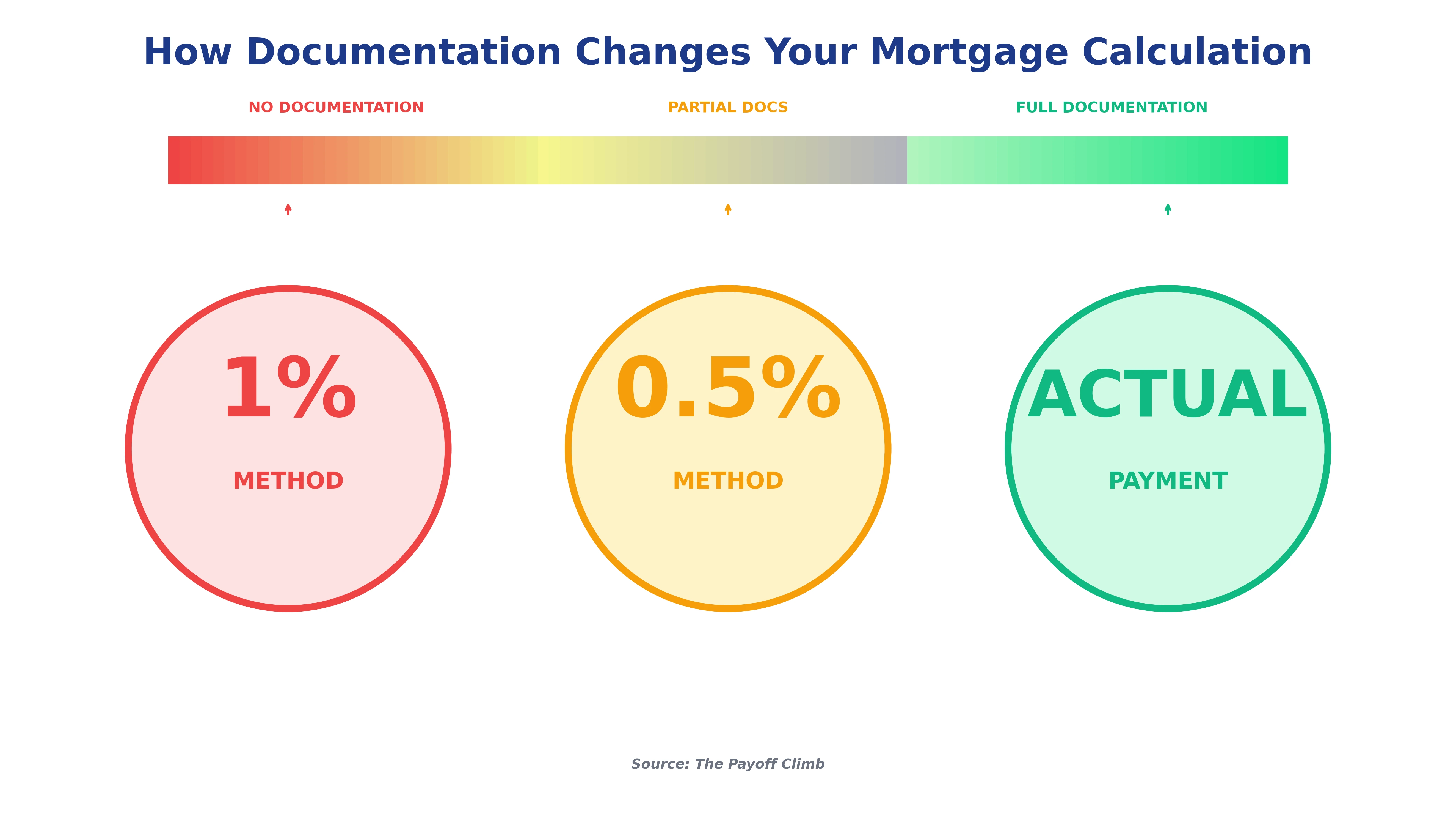
The monthly payment lenders use for DTI is not always what you are actually paying. FHA mortgages use one of three methods:
| Calculation Method | When It Applies | How It Works |
|---|---|---|
| Actual Payment | Credit report shows payment > $0 | Lender uses exact payment from credit report |
| 1% of Balance | Payment is $0 or deferred | 1% of total balance as monthly payment |
| 0.5% of Balance | You document income-driven repayment | 0.5% of balance with IDR proof |
Table 1: FHA Loan Student Loan Calculation Methods.
With $100,000 in student loans, the difference is substantial: 1% method = $1,000/month toward DTI, while 0.5% method = $500/month. Your actual IDR payment may be only $200-400/month.
Conventional loans may accept a documented $0 IDR payment at face value, while FHA loans default to the percentage calculation.
Scenario: Getting a Mortgage with $100k in Student Debt
Meet Sarah:
- Gross monthly income: $6,500
- Student loan balance: $100,000 (SAVE plan, $184/mo payment)
- Other debts: $350/month car payment
- Target home: $500,000 (5% down)
- Proposed mortgage (PITI): $2,678/month
| Documentation Provided | Lender’s Calculation | Total Monthly Debt | DTI | Result |
|---|---|---|---|---|
| None (FHA Default) | 1% of balance = $1,000 | $4,028 | 62.0% | REJECTED |
| IDR Notice Only (FHA) | 0.5% of balance = $500 | $3,528 | 54.3% | REJECTED |
| Full Documentation (Conventional) | Actual payment = $184 | $3,212 | 49.4% | MARGINAL |
| Full Documentation + Car Paid Off | $184, no car payment | $2,862 | 44.0% | LIKELY APPROVED |
Table 2: Impact of Student Loan Calculation Methods.
Sarah’s balance is identical, $100,000, but her DTI swings from 62% (automatic rejection) to 44% (possible approval) based solely on strategic debt payment, calculation method, and documentation. This is why documenting your income-driven repayment plan can mean the difference between qualifying and not qualifying.
III. Credit Scores and Daily Living
Your student loans shape your financial life beyond mortgage qualification. They affect whether you can rent an apartment or rebuild credit after setbacks. Understanding how student loans affect your credit score is essential because the impact depends on whether your loans are classified as installment debt and how payment history compounds over time.
Will Student Loans Affect My Credit Score? (Installment vs. Revolving)
Yes, but not like credit cards. Student loans are installment loans, treated differently than revolving credit by scoring models.

Federal student loans are reported to all three credit bureaus and impact your FICO score across five factors:
Payment History (35%): Every on-time payment builds positive history. Late payments (30+ days past due) remain on your credit report for seven years.
Amounts Owed (30%): Unlike credit cards where utilization ratio matters heavily, your student loan balance doesn’t penalize you the same way. Consistent, on-time payments matter most.
Length of Credit History (15%): Student loans often represent your first credit account, establishing 4-6 years of history by graduation.
Credit Mix (10%): Having both installment debt and revolving credit demonstrates responsible credit management.
Deferment and Forbearance: Loans in deferment report as “current” and don’t hurt your score, but you are not building payment history during these periods.
Rehabilitation After Default: Complete rehabilitation (9 on-time payments within 10 months) removes the default notation from your credit report. It is one of the few ways to eliminate negative information before the seven-year period.
Can I Use Student Loans For Rent While Saving For a House?
Yes, federal student loans legally cover housing costs. According to federal regulations, student loans can be used for any expense in your school’s cost of attendance (COA):
- Housing (rent, utilities, insurance)
- Food (groceries, meal plans)
- Transportation (gas, insurance, parking)
- Books and required technology
- Childcare expenses
- Health insurance
You cannot use student loans to purchase a vehicle outright because it is not part of COA. However, you can cover transportation costs like gas and insurance for a car you already own.
Strategic Reality: If you are enrolled at least half-time, your federal loans are likely in in-school deferment, meaning no payments are due. During this period, your loans don’t count against DTI, you can use loan refunds for living expenses while saving for a down payment, and you are building credit history.
Trade-off: Borrowing $18,000/year for rent over four years of graduate school equals $72,000 in principal you will repay over 10-25 years, a burden that will affect mortgage qualification later.
IV. Strategic Financial Planning
Should You Pay Off Loans or Save for the Down Payment?
When every extra dollar could either reduce your student loan balance or grow your down payment fund, the math depends on three factors: how lenders verify your student loans, whether your loan interest rate exceeds investment returns, and whether accelerated payoff would meaningfully improve your DTI.
The strategic reality: paying off student loans only helps mortgage qualification if it lowers your DTI or frees monthly cash flow. A $10,000 payment on a $100,000 balance might feel significant, but if you are on income-driven repayment with a $200 monthly payment, that $10,000 doesn’t change your DTI because lenders use your actual payment, not your balance.
Verifying Student Loans For a Mortgage: What Lenders Look For
Mortgage lenders verify federal loans through the National Student Loan Data System (NSLDS), showing your balance, servicer, and repayment status. However, NSLDS does not show your monthly payment; that comes from other documentation.
For Income-Driven Repayment: To use your actual $0 or low payment (rather than the 0.5% or 1% calculation), provide:
- Recent billing statement showing the payment amount.
- IDR recertification notice for the current year.
- Signed servicer letter stating your monthly obligation.
For Deferment/Forbearance: Lenders still count these loans using calculation formulas even though your current payment is $0.
For Default: You generally cannot qualify for FHA loans until you have completed rehabilitation or entered a repayment agreement with 3 consecutive payments.
Gather before mortgage shopping:
- Current credit report
- NSLDS summary
- Recent servicer billing statements
- IDR recertification notice if applicable
The 50/30/20 Rule For Student Loans and Homeownership
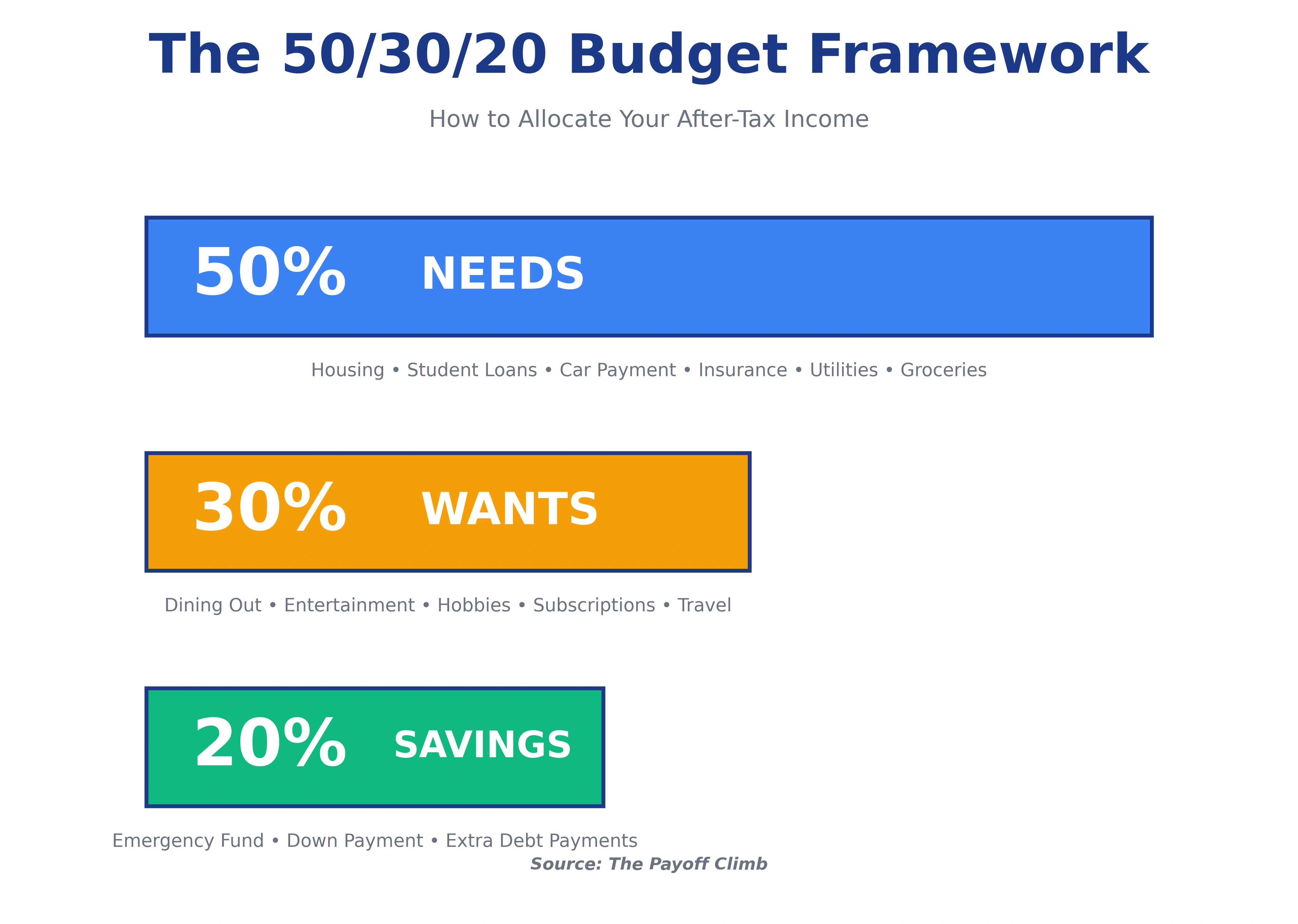
The 50/30/20 framework (50% needs, 30% wants, 20% savings) requires adaptation when balancing student debt with down payment goals. Student loan payments count as “needs,” but accelerated payoff comes from your “savings” bucket, creating strategic tension.
Meet David:
- Gross-monthly income: $6,250
- After-tax monthly income: $5,000
- Rent: $1,279 | Student loans (SAVE): $171 | Car: $350 | Other needs: $700
- Total needs: $2,500 (50%)
- Available for savings: $1,000 (20%)
| Category | Amount / Metric | % of After-Tax Income |
|---|---|---|
| After-Tax Monthly Income | $5,000 | 100% |
| Total Essential Needs | $2,500 | 50% |
| Available for Savings/Extra Debt | $1,000 | 20% |
| Gross Monthly Income (Est.) | $6,250 | -- |
Table 3: David’s budget allocation.
Scenario A: Down Payment Priority:
- Saves $1,000/month → $36,000 in 3 years
- Student loan payment: $171/month
- DTI: ($171 + $350) / $6,250 = 8.3%
- Could afford $2,169/month mortgage payment
Student Loan Balance after 3 years: $50,000**
- Monthly interest: ~$271
- Payment: $171
- **Government subsidizes remaining $100/month under SAVE
- No balance growth
- SAVE payment remains $171 throughout
Scenario B: Hybrid Approach
- $750/month to down payment, $250/month extra to loans
- Required SAVE payment: $171/month
- Extra principal payment: $250/month
After 3 years:
- Down payment saved: $27,000
- Extra payments made: $9,000
- Student Loan Balance: $50,000 - $9,000 = $41,000**
- **No interest accrual because government subsidy covers the gap
- SAVE payment: Still $171 (unchanged: based on income, not balance. Assuming stagnant salary)
- DTI: Still 8.3% (unchanged)
| Metric | Scenario A (Save for Down Payment) | Scenario B (Hybrid) |
|---|---|---|
| Down payment saved | $36,000 | $27,000 |
| Extra loan payments | $0 | $9,000 |
| Starting balance | $50,000 | $50,000 |
| Ending balance | $50,000 (subsidy prevents growth) | $41,000 (extra payments reduce it) |
| SAVE monthly payment | $171 | $171 |
| DTI | 8.3% | 8.3% |
| Mortgage capacity | $2,169/month | $2,169/month |
Table 4: Mortgage Approval Comparison for $50k Student Debt.
Decision Framework:
| Your Situation | Priority Allocation |
|---|---|
| IDR plan + high-cost housing market | 80% down payment, 20% loans |
| Standard plan + DTI above 35% | 60% loans, 40% down payment |
| Loan interest rate > 7% | 70% loans, 30% down payment |
Table 5 : Strategic allocation based on repayment plan.
The Mathematical Reality: If home prices appreciate 5% annually, waiting four years means today’s $400,000 home costs $486,000 later. Conversely, if you are paying 8% interest on private loans while housing prices decline, accelerated payoff makes clear sense.
V. Frequently Asked Questions
Q. Are student loans considered debt for mortgage purposes?
A: Yes. Student loans are installment debt and count toward your debt-to-income ratio when applying for a mortgage. Even if your loans are in deferment, forbearance, or on an income-driven repayment plan with a $0 monthly payment, lenders factor them into DTI calculations using either your actual payment or a percentage of your balance (0.5% to 1%) depending on loan type and documentation.
Q. Who is responsible for student loans in a divorce?
A: Student loan responsibility in divorce depends on when the loans were taken out and your state’s property laws. In community property states, debts incurred during marriage may be considered marital property regardless of whose name is on the loan. In equitable distribution states, courts divide debts based on fairness, often assigning each spouse their own educational debt. If one spouse cosigned the other’s loans, both remain legally liable to the lender regardless of divorce settlement terms.
Q. Will student loans go away after I pay them off?
A: Once you pay off federal student loans in full, your servicer reports them as “paid in full” to credit bureaus, and the accounts remain on your credit report for up to 10 years in positive standing. This continued reporting benefits your credit score by maintaining payment history and credit mix. Your monthly obligation disappears immediately, improving your debt-to-income ratio for future borrowing.
Q. How do I remove student loans from my credit report after default?
A: If you defaulted on federal student loans and successfully complete rehabilitation, making nine on-time monthly payments within 10 months, the default notation is removed from your credit report. This is one of the few ways to eliminate negative information before the standard seven-year period. Your credit score can improve significantly within months of completing rehabilitation, though the late payments that led to default may still appear.
V. Conclusion
Buying a house with student loans is not about eliminating your debt, it is about understanding the formulas lenders use and positioning your finances accordingly. The difference between approval and rejection often comes down to documentation: providing proof of your income-driven repayment plan, choosing the right loan type, and timing your application when your DTI is most favorable.
Three insights matter most: Your student loan balance is less important than your monthly payment for DTI calculations. The gap between FHA’s calculation methods and conventional loans’ flexibility can mean $50,000-100,000 in additional borrowing power. The decision to pay off loans or to save for a down payment has a mathematically optimal answer based on your repayment plan type, loan interest rates, and local housing market conditions.
Start by gathering documentation: pull your credit report, log into the National Student Loan Data System, and request current billing statements from your servicers. If you are on income-driven repayment, get written confirmation of your monthly payment amount. Having these documents ready can accelerate your timeline by weeks.
Run your own numbers using the DTI formulas in this guide. Calculate your back-end ratio with your actual payment, then compare it to what lenders would calculate using the 0.5% or 1% methods. If the difference is significant, prioritize documentation over debt payoff. If your DTI is comfortably below 43%, focus your extra cash on building that down payment fund.
The mortgage process rewards preparation and precision. Homeownership with student debt is still possible in 2026. For borrowers who understand the math and document their situation properly, it is entirely achievable.